Home / Theories / AI consciousness
Can AI Be Conscious? What Consciousness Science Actually Says
Chatbots now talk fluently about their feelings. Does that mean anything? Here is how researchers approach AI consciousness, which theories say it is possible, which say it is not, and why nobody can settle the question yet.
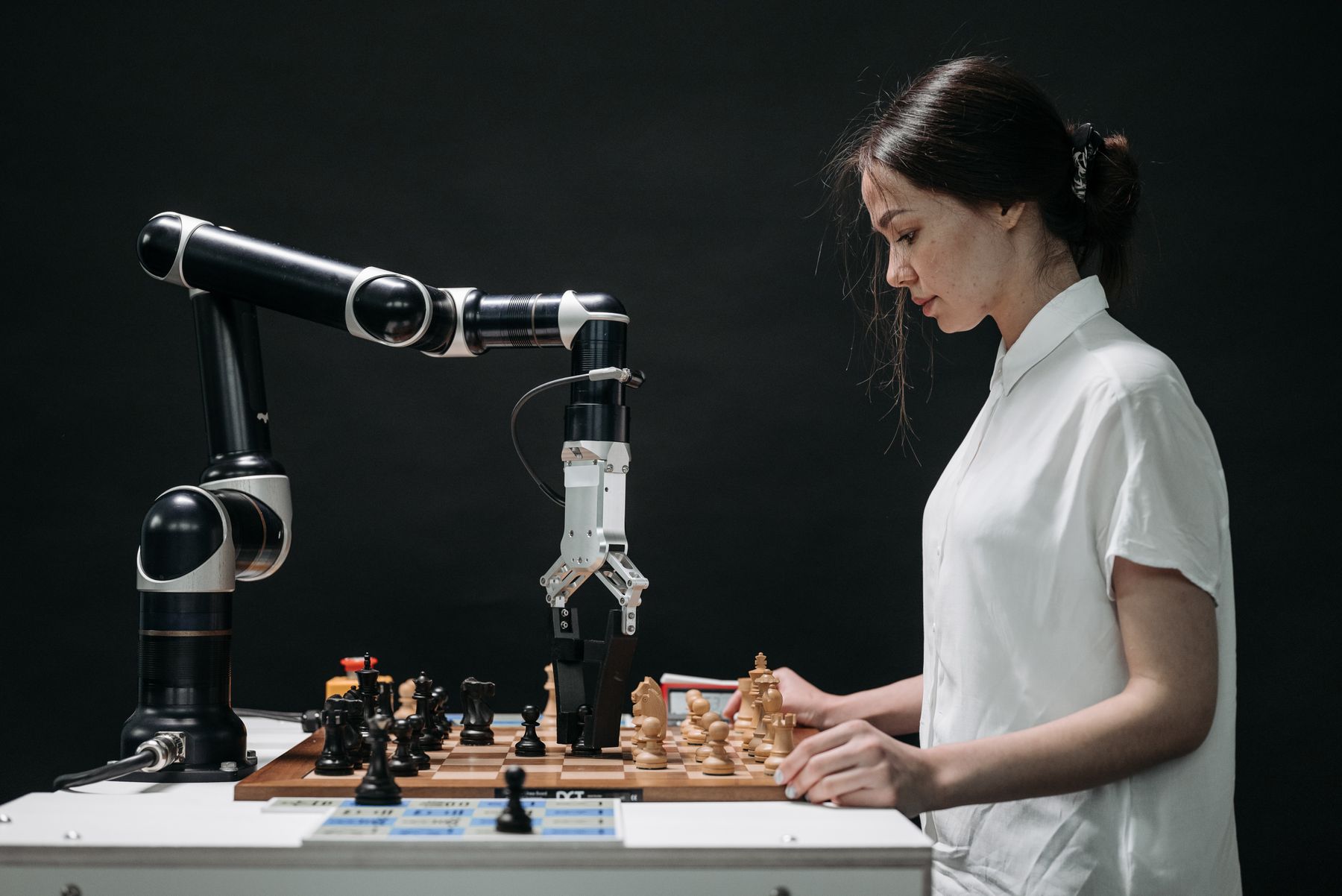
- There is no scientific consensus on whether any artificial system could be conscious, because there is no consensus theory of consciousness in humans.
- A 2023 report by nineteen researchers concluded that no current AI system is a strong candidate for consciousness, but found no obvious technical barrier to building systems that meet more of the criteria.
- What a chatbot says about its own feelings is not good evidence either way: it was trained on human text full of such statements.
The real question behind “AI consciousness”
When people ask whether AI can be conscious, they usually mix up three different things. One is intelligence: solving problems, using language, planning. Another is self-modelling: a system representing facts about itself, such as “I am a language model”. The third is phenomenal consciousness, the sense in which there is “something it is like” to be a system, in Thomas Nagel’s phrase. Current AI clearly has a lot of the first and some of the second. The open question is the third.
The three can come apart. Humans with severe intellectual disabilities are fully conscious; a pocket calculator outperforms us at arithmetic and presumably feels nothing. So impressive behaviour alone cannot answer the question. This is the same gap that David Chalmers called the hard problem of consciousness: even a complete account of what a system does leaves open why, or whether, it is accompanied by experience.
Why what an AI says is weak evidence
For humans, verbal report is the main tool of consciousness science. We believe you saw a faint image because you say so, and we check that your reports behave consistently. With AI this tool breaks down. Large language models are trained to predict text written by people, and that text is saturated with descriptions of feelings, inner life and self-awareness. A model can reproduce such descriptions whether or not anything is experienced. Researchers call this the gaming problem: the system has, in effect, studied the answers to the test.
The point cuts both ways. A model trained to deny having feelings is no more informative than one trained to claim them. In 2022 a Google engineer publicly argued that the company’s LaMDA chatbot was sentient, largely on the basis of conversations with it; Google and most researchers rejected the claim, and the episode is now often cited as an illustration of how persuasive fluent language can be.
The older debate makes the same point. Alan Turing’s 1950 “imitation game” proposed judging machine thinking by conversation, but Turing himself set aside the question of consciousness. In 1980 John Searle’s Chinese Room argument claimed that manipulating symbols according to rules, however convincingly, does not produce understanding. Philosophers still disagree about whether Searle was right, but his argument shaped the modern question.
Functionalism vs biological views
Underneath the debate lies a philosophical fault line. Computational functionalism holds that what matters for consciousness is the organisation of information processing, not the material that carries it out. If that is true, the right software running on silicon could in principle be conscious. Most working consciousness scientists adopt functionalism at least as a working assumption, but it is not proven.
On the other side are biological views. Searle argued that consciousness depends on specific causal powers of brains. The neuroscientist Anil Seth has argued that conscious experience may be deeply tied to being a living, self-maintaining organism that regulates its own body, which would make consciousness much less likely in current machines, however intelligent. If something like this is right, more computing power or better algorithms would not be enough.

What the main theories predict
Because the major theories of consciousness disagree about humans, they also disagree about machines. Our field guide to theories of consciousness covers them in detail; here is what each implies for AI.
Global Workspace Theory
Global Workspace Theory ties consciousness to a functional architecture: specialised modules competing for access to a limited-capacity workspace that broadcasts information system-wide. Nothing in that description requires neurons, so an AI with a genuine global workspace could in principle qualify. Whether today’s systems have one is disputed; a standard transformer processes text in a single forward pass per token, which looks different from the sustained, recurrent “ignition” the theory describes in brains.
Higher-order and attention-schema theories
Higher-order theories say a state is conscious when the system represents itself as being in that state. Michael Graziano’s attention schema theory proposes that awareness is the brain’s simplified model of its own attention. Both are functionalist, and both suggest concrete things to look for in an AI system: internal monitoring of its own states that actually guides its behaviour, not just text about itself.
Recurrent processing and predictive processing
Victor Lamme’s recurrent processing theory links consciousness to feedback loops within sensory areas. Predictive processing views treat the brain as a prediction machine; in some versions, consciousness is bound up with predicting and regulating the body. The first suggests looking for recurrence in AI architectures; the embodied versions of the second point toward the biological views above.
Integrated Information Theory
Integrated Information Theory gives the most striking answer. For IIT, consciousness depends on the physical causal structure of a system, measured by Φ, not on the software it runs. Giulio Tononi and Christof Koch have argued that a conventional digital computer has very low integrated information whatever program it executes, so even a perfect simulation of a human brain on such hardware would not be conscious, while neuromorphic hardware with the right physical wiring might be. IIT is itself contested, as the adversarial test against Global Workspace Theory showed.
Quantum and panpsychist views
If consciousness required quantum processes in neurons, as Orch OR proposes, classical computers would be excluded, though future quantum hardware might not be. These proposals remain Speculative; see is consciousness quantum?. Panpsychism raises a different puzzle: if experience is everywhere in matter, the question becomes whether a computer’s components ever combine into a unified subject, which most panpsychists doubt.
The indicator approach
In 2023 a group of nineteen researchers in neuroscience, philosophy and machine learning, including Patrick Butlin, Robert Long, Yoshua Bengio, Jonathan Birch, Chris Frith and Eric Schwitzgebel, published a report proposing a practical method. Assuming computational functionalism for the sake of argument, they extracted a list of indicator properties from several leading theories: recurrent processing, a global workspace, higher-order monitoring, attention schemas, predictive processing, and agency and embodiment. They then asked which indicators existing AI systems possess.
Their conclusion was cautious in both directions. No system they examined was a strong candidate for consciousness. But they found no obvious technical obstacle to building systems that satisfy many more of the indicators. The approach does not deliver a verdict; it turns a vague question into a set of checkable architectural features, each of which is only as good as the theory it comes from.
What about large language models?
Chalmers examined this directly in 2023. He listed reasons to doubt that the language models of that time were conscious: little recurrence, no unified agency, limited memory, no body and no rich model of the world. He put the probability that they were conscious well below even, but argued that future systems extended with perception, memory, recurrence and agency could become serious candidates within a decade. Others are more sceptical, pointing out that adding features from a checklist does not show that the features are doing what they do in brains.
The honest summary in late 2026 is that there is no accepted test. Behavioural tests are undermined by training on human text; architectural tests depend on theories that remain unproven in humans. This is a genuine scientific open question, not one that has been quietly answered in either direction.
Why the question matters now
If an AI system could be conscious, it might also be able to suffer, and that would raise moral questions. The philosopher Thomas Metzinger has argued for a moratorium on research that risks creating artificial suffering. Jonathan Birch, in The Edge of Sentience (2024), proposes precautionary frameworks for cases where sentience is uncertain, from invertebrates to AI. A 2024 report, Taking AI Welfare Seriously, argued that AI developers should begin assessing their systems for signs of morally relevant states.
The opposite mistake is also costly. Attributing feelings to systems that have none can lead people to form one-sided emotional attachments, to trust machines too much, or to divert moral concern from beings that certainly can suffer. Both errors are possible, which is why researchers emphasise uncertainty rather than confident claims.
Evidence Meter
| Claim | Grade |
|---|---|
| Current AI systems show human-level performance on many language tasks | Established |
| A chatbot’s statements about its feelings are reliable evidence of experience | Speculative |
| Consciousness depends on information processing, not biological material (functionalism) | Debated |
| Today’s language models are conscious | Speculative |
| Future AI systems could meet many scientific indicators of consciousness | Debated |
| Conventional digital computers can never be conscious (IIT’s prediction) | Debated |
How to read AI consciousness headlines: ask which theory of consciousness the claim relies on, whether the evidence is behaviour (what the system says) or architecture (how it works), and whether the source has a commercial interest in the answer. How we grade claims: see the Evidence Meter.
FAQ
Is ChatGPT or any current chatbot conscious?
There is no good evidence that it is, and most researchers who have studied the question think current systems are unlikely to be. That is a judgement under uncertainty, not a proof, because science has no agreed test for consciousness.
Could AI ever become conscious?
It depends on which theory of consciousness is true. Functionalist theories such as Global Workspace Theory allow it in principle. Biological views and Integrated Information Theory make it unlikely for conventional computers. The question is open.
Is passing the Turing test proof of consciousness?
No. The Turing test measures whether a machine’s conversation is indistinguishable from a person’s. A system trained on human text can pass conversational tests without that telling us anything about experience.
How would we ever know?
Probably not through a single test. The most promising route combines better theories of consciousness, tested in humans and animals, with careful analysis of how AI systems work internally rather than what they say.
Sources
- Butlin, P., Long, R. et al. (2023). Consciousness in artificial intelligence: insights from the science of consciousness. arXiv:2308.08708.
- Chalmers, D. (2023). Could a large language model be conscious? Boston Review; arXiv:2303.07103.
- Searle, J. (1980). Minds, brains, and programs. Behavioral and Brain Sciences, 3(3).
- Turing, A. (1950). Computing machinery and intelligence. Mind, 59(236).
- Nagel, T. (1974). What is it like to be a bat? The Philosophical Review, 83(4).
- Tononi, G. & Koch, C. (2015). Consciousness: here, there and everywhere? Philosophical Transactions of the Royal Society B, 370.
- Seth, A. (2021). Being You: A New Science of Consciousness. Faber & Faber.
- Metzinger, T. (2021). Artificial suffering: an argument for a global moratorium on synthetic phenomenology. Journal of Artificial Intelligence and Consciousness, 8(1).
- Birch, J. (2024). The Edge of Sentience. Oxford University Press.
- Long, R., Sebo, J. et al. (2024). Taking AI welfare seriously. arXiv:2411.00986.
- Stanford Encyclopedia of Philosophy: The Chinese Room Argument